Wednesday, February 13, 2008

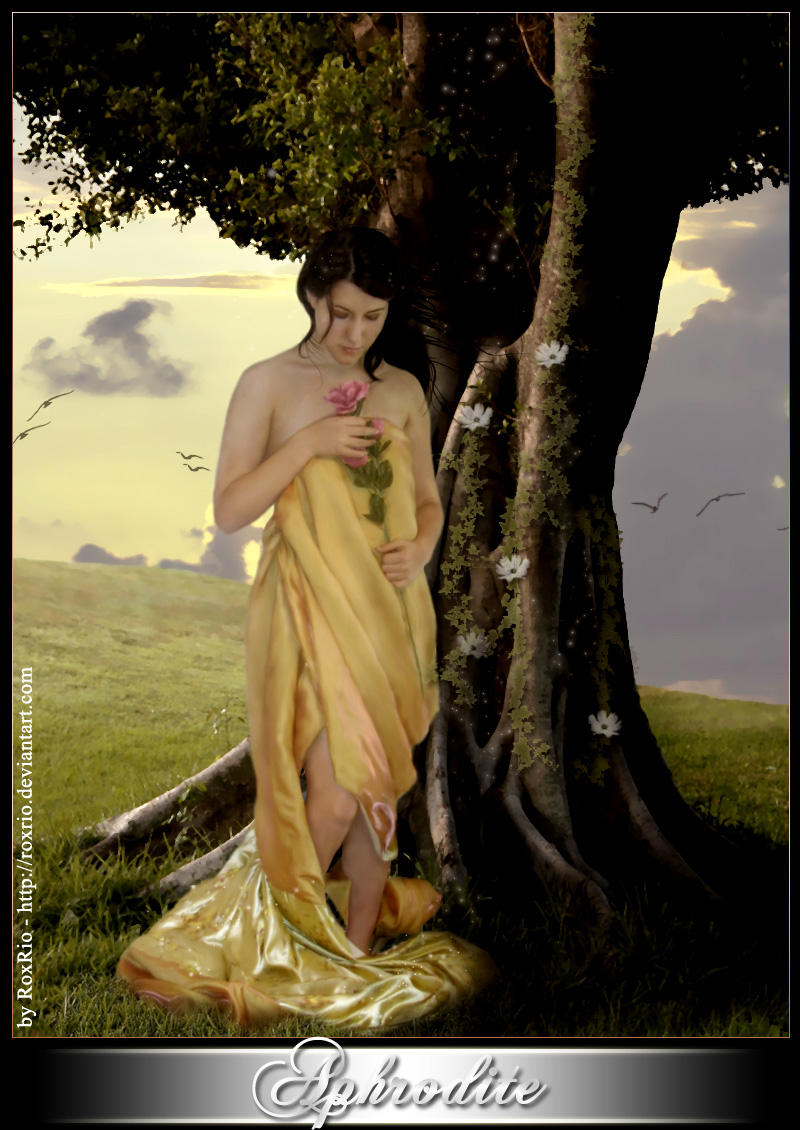
Aphrodite

Aphrodite was a Greek goddess of love, beauty and sexual rapture. Her Roman equivalent is Venus. She is directly related to the ancient fertility goddesses and mother goddesses, such as Hathor, Isis, and Astarte. In fact some authorities suggest Aphrodite was Phoenician and was the sister of the Assyro-Babylonian Ishtar and the Syro-Phoenician Astarte. According to some mythological accounts, she was born from the churning and foaming of the sea when Kronos threw Ouranos’s severed genitals into the water (the Greek aphros means “sea foam”), but this story arose later. In it, Aphrodite arose from the roiling sea and was borne by the waves to Cyprus. At the Cyprian city of Paphos, a temple was erected to her.

In origin, Aphrodite was obviously a fertility goddess. Her domain covered all of nature, animal and plant. She grew to be viewed in many aspects: as Aphrodite Urania, the goddess of pure love; Aphrodite Genetrix, or Nymphia, goddess of marriage (she was prayed to by unmarried women and widows); Aphrodite Pandemos (common) and Aphrodite Porn (courtesan) as the goddess of lust and venal love, and patroness of prostitutes. She was also Aphrodite the Warrior, represented helmeted and carrying arms. She was so worshiped at Sparta.

Aphrodite was married to Hephaestus, the god of fire, metalwork and craftsmanship, but was loved by many others, gods and humans. It is said that she roused the passionate desires of all the immortals and all came under her influence, with the exception of Athene, Artemis and Hestia. Her cult, in one form or another, was found throughout the Mediterranean lands. Festivals in her honor, known as Aphrodisia, were common.

Many witches use the name of Aphrodite as the goddess they worship, while others include her in their listings of honored deities. Of the many symbols sacred to her were the dove, sparrow, goose, and swan, the goat, the lynx, and the dolphin. Sacred plants included the rose, myrtle, quince, clover and watermint. Friday is sacred to her and her special festivals are on April 1 and 23, June 23 and July 19. She is associated with the zodiacal signs Taurus and Libra, and connected with the throat, kidneys and lumbar region.

Monday, February 11, 2008

Flagellation

Devotees of the goddess Isis, priests of Cybele, followers of Dionysus, the ancient Greek cult of the Spartans, and other religious followers of many different persuasions have recognized flagellation, or ritual scourging, as a necessary part of religious rites. In its broadest sense it is a spiritual cleansing.

The life-size frescos on the walls of the Initiation Room at the Villa of the Mysteries, just outside Pompeii, Italy, in clued a scene showing a priestess of Dionysus scourging and initiate. In the Wiccan initiation there is a similar ritual scourging as part of the palingenesis, which is the central theme of all initiations. It is a symbolic death prior to rebirth. Since it is symbolic, it is not designed to hurt the neophyte. The Wiccan scourge, in fact, is a whip made with thongs of silk or a similarly soft material. They are not knotted or in any way enhanced to produce pain.

Flagellation, or scourging, is also used by some witches to raise power when working magic. There are many ways of raising this cone of power—dancing, changing, singing, or sex, for example—and ritual scourging is one of them. Here again, the design is not to bring pain. The recipient (in some traditions this would be the priestess of the coven) is repeatedly scourged, but the thongs of the instrument are drawn across the body repeatedly in an almost hypnotic movement. The Book of Shadows, the coven’s ritual text, states that “the Scourge is used to bring blood to the surface of the skin, not to hurt.”

Yet the witchcraft practiced in the Middle Ages included a scourging that was designed to hurt. In the records of the 1662 trial of the Scottish Auldearne witches, Issobel Gowdie spoke of the leader of the coven beating them: “He would beat and buffet us very sore. We would be beaten if we were absent any time, or neglect anything that would be appointed to be done…He would be beating and scourging us all up and down with cords and other sharp scourges.” Of the Northumberland witches (1673), it was reported, “All of them who had done harm gave an account thereof to their protector, who made most of them that did most harm and beat those who had done no harm.”

Tuesday, February 05, 2008

Lycanthropy

Lycanthropy is the transformation of a human being in to the form of a wolf. The term is derived from the Greek words lukos, meaning wolf, and anthropos, meaning man. Such a human, transformed, is known as a werewolf. This term derives from the Anglo-Saxon wer, meaning man, and wulf, meaning wolf. There are countless folk tales of werewolves coming from every country in the world where there is or was a presence of wolves. In other countries that have not known the wolf, there are folk tales of such things as weretigers, werebears, werefoxes, wereleoopards and werepanthers.

Some people believed that the only transformation that occurred was purely in the mind of the person. In other words, no physical changes took place. The affected individual merely believed that the changes had occurred. Yet there were numerous well-documented cases —including several in France in 1598—that appeared to show otherwise.

Throughout the time of the witchcraft trials at the end of the 16th century, there were several of cases of lycanthropy. Geiler von Kayserberg’s book on witchcraft, Di Emeis (Strasbourg, 1517), includes an illustration of a man being attacked by a werewolf. The Révérend Père M. Mar. Guaccius’s Compendium maleficarum (Milan, 1626) has an engraving of a witch transformed into a wolf. A variety of German works of the 16th and 17th centuries also show these types of pictures. In many of the witch trials in Britain, evidence was offered of witches transforming themselves into a variety of animals, including rabbits, cats, dogs, crows and wolves. In 1573, Gilles Garnier of Dole, France admitted to becoming a werewolf and killing a ten-year-old girl, ripping her body to pieces with his claws and teeth. In 1589, Peter Stumpf of Bedburg, near Cologne, under torture confessed that he changed into such an beast with the aid of magic belt that was given to him by the devil. He could change back into human form, he said, by taking off the belt. Among others, Stumpf killed his own son and twelve other children, plus two young women and various livestock. He and his daughter were sentenced to be horribly tortured then burnt alive at the stake..

The Roman poet, Vergil, in his Eclogues (c. 20 BCE), wrote, “Often have I seen Moeris turn into a wolf and hide in these woods: often too have I seen him summon the spirits from the depths of the tomb and transfer crops elsewhere.” Pliny the Elder (23-79 CE) spoke of someone of the clan of Anthius, who was chosen by vote of the family and led away to a particular pool in the region of Arcadia. There he hung his clothes on an oak tree, swam across the pool, and went into the woods on the far side to transform into a wolf. He remained in that form for nine years before swimming back across the pool and changing back into a man. According to William Stokes (Religion of the Celts, 1873), St. Patrick cursed a certain race in Ireland so that every seven years they and their descendants would become werewolves.


Technorati tags: ,

Calming the Mind and Body

Learning to calm the mind and body is particularly essential in reducing stress. When the mind and body are at peace, stress seems to just melt away. Relaxation exercises are among the simplest methods for quieting the body and mind. The purpose of relaxation techniques is to bring about a physiological response known as the relaxation response – a response that is the exact opposite of the stress response. While you may relax by simply sleeping, watching television, or reading a book, relaxation techniques are specifically intended to produce the relaxation response.

In order to achieve the relaxation response, a broad range of techniques can be utilized. It doesn’t really matter which technique you use; ultimately, they all should produce the same physiological state of deep relaxation. Some popular techniques are meditation, prayer, progressive self-hypnosis, relaxation, and biofeedback. The type of relaxation technique that works best for each person is entirely individual. The important thing is that you set aside at least five to ten minutes each day to perform a relaxation technique.

Breathing With The Diaphragm
Producing deep relaxation with any technique involves learning how to breathe. Breathing with the diaphragm is one of the most powerful ways to decrease stress and increase energy in the body. By using the diaphragm to breathe, your physiology can be changed considerably, literally triggering the relaxation centers in the brain.

Here is a popular way to learn to breathe with your diaphragm.

  • Find a quiet, comfortable place to sit or lie down.
  • Position your feet slightly apart and place one hand on your abdomen near your navel and place your other hand on your chest.
  • Inhale through your nose and exhale through your mouth.
  • Focus on your breathing. Notice which hand is rising and falling with each breath.
  • Gradually exhale the air in your lungs.
  • Inhale while slowly counting to four. As you inhale, extend your abdomen a bit, causing it to rise about 1 inch. Make certain that you’re not moving your chest or shoulders.
  • As you inhale, visualize the warm air flowing in to all parts of your body.
  • Pause for one second, and then slowly exhale to a count of four. As you exhale, your abdomen should move inward.
  • As the air flows out, visualize all your worry and stress fading away.
  • Repeat this exercise until you have achieved a sense of deep relaxation.

Progressive Relaxation

One of the most popular methods for achieving the relaxation response is progressive relaxation. Many people are unaware of the sensation of relaxation. In progressive relaxation, you learn what it feels like to relax by comparing relaxation to muscle tension. This technique is often used in the treatment of anxiety and insomnia.

The idea is to forcefully contract a muscle for one to two seconds and then give way to a feeling of relaxation. Since the procedure runs progressively through all the muscles of the body, eventually a deep state of relaxation will result.

Start by contracting the muscles of your face and neck, and holding the contraction for a at least two seconds and then relaxing the muscles. Then, contract and relax the muscles in your upper arms and chest, and then the muscles in your lower arms and hands. Gradually repeat this process down your body from your abdomen, buttocks, thighs, calves, down to your feet. Repeat the whole series two or three more times.


Technorati tags: , ,

Saturday, February 02, 2008

Artemis (Diana)

Daughter of Zeus and Leto and twin sister of Apollo, Artemis was one of the twelve great gods and goddesses of Olympus. She was a Greek goddess mainly associated with wildlife and with human birth. She was originally one of the great Mother Goddesses, with emphasis on her role as virgin huntress and patroness of chastity. As Apollo's twin sister, she is regarded as a divinity of the light, specifically the light of the "mon", and such has been an influential archetype for witches. Her symbol is the female bear and she is associated with the constellation Ursa Major.

Legend has it that she was born on the sixth day of the month of Thargelion, a day before her brother. As she grew up in her favorite Arcadia, she would hunt accompanied by sixty young Oceanids and twenty-nymphs. Armed with bow and arrows given to her by Zeus, she gained the epithet Apollousa, "the destructress," and was a deity of sudden death. She was especially venerated in Arcadia but was also worshiped throughout Greece, Crete, and Asia Minor.

Her Roman equivalent is Diana, described as "the eternal feminist." She is the source of magical power for witches, who gather to adore her at the full of the moon. The Canon Episcopi of the tenth century condemned those who "believe and profess themselves, in the hours of the night to ride upon certain beasts with Diana, the goddess of the pagans." She is a slim, beautiful virgin, usually depicted with her hair drawn back and wearing a short tunic--a Dorian chiton. She is frequently accompanied by either a young hind or a dog. As goddess of fertility , she is sometimes depicted with many breasts.

Artemis made chastity a strict law, although she did fall in love with Orion, whom she later shot in the head when tricked into doing so by Apollo. She had a dark and vindictive character and many were punished by death or torment when they crossed her or forgot to pay her reverence. Yet she could also be gentle and loving. She was also a music goddess and lover of singing and dancing.

Most Wiccans honor Artemis/Diana as part of the triple goddess aspect of the moon, and as a nurturer and protector. She has inspired the Dianic, strongly feminist, tradition of Wicca.


Technorati tags: , , , , , greek mythology, , , ,